This 7-day, 6-night Azerbaijan tour covers Baku, Gobustan, Absheron, Shamakhi, Gabala, Sheki, Guba and Khinalug. Transfers, a guide, lunches during the excursions and entrance tickets are already included in the price. You only need to choose a hotel and a date.
7-Day Azerbaijan Tour: Baku, Sheki, Gabala, Khinalug
₼350
Tour Itinerary
Meeting at the airport and transfer to your hotel. Arrival and check-in.
The journey begins at the Heydar Aliyev Center — one of the most recognizable architectural masterpieces in modern Azerbaijan, created by the legendary architect Zaha Hadid. Its flowing white curves and futuristic design have turned the building into a symbol of contemporary Baku and the country’s modern identity. Even before entering the complex, visitors are impressed by the innovative architecture and the sense of movement reflected in its unique form.
Inside the center, guests explore exhibitions dedicated to Azerbaijani culture, history, art, and national development, along with temporary installations and a famous collection of classic automobiles. Around two hours are allocated for this stop, allowing travelers to comfortably enjoy one of the most remarkable cultural spaces in the Caucasus region.
The next part of the route introduces guests to the Heydar Mosque — one of the largest and most beautiful mosques in the Caucasus. The elegant combination of traditional Islamic architecture and modern design creates a calm and harmonious atmosphere from the very first moments of the visit. Bright stone facades, graceful minarets, and refined decorative details make the complex especially impressive.
The interiors are decorated with intricate calligraphy, traditional ornaments, and delicate carvings reflecting the rich spiritual culture of Azerbaijan. Visiting this landmark allows travelers to better understand the country’s religious traditions and cultural identity through architecture and artistic design.
During the program, guests enjoy a lunch break featuring traditional Azerbaijani cuisine and local hospitality. The menu includes qutab, rice, assorted kebabs, fresh salad, bread, soft drinks, and aromatic Azerbaijani tea, which holds a special place in the country’s culinary traditions.
This gastronomic stop adds another dimension to the journey, allowing visitors to experience local culture not only through architecture and history, but also through authentic national flavors. For many travelers exploring tours in Azerbaijan, traditional cuisine becomes one of the most enjoyable parts of the experience.
After lunch, the route continues to Highland Park — the main panoramic viewpoint of the capital overlooking Baku Bay and the central districts of the city. From the terraces above the coastline, visitors enjoy spectacular views of the Caspian Sea, Baku Boulevard, Crystal Hall, the Ferris wheel, and the modern skyline stretching across the waterfront.
This section of the Baku City tour offers some of the best photo opportunities in the capital. The famous Flame Towers appear especially impressive from this viewpoint, while the combination of sea panoramas and contemporary architecture perfectly reflects the unique atmosphere of modern Baku.
The program then moves to Baku Boulevard — one of the most elegant seaside promenades along the Caspian coast. Green parks, coastal walkways, modern public spaces, and fresh sea air create a relaxing atmosphere that contrasts beautifully with the busy energy of the city center.
Particular charm comes from Little Venice, where decorative canals, bridges, and gondolas create the feeling of a small European resort in the heart of Baku. Within this part of the route, guests enjoy a softer and more peaceful side of the capital, while the surrounding waterfront area offers excellent opportunities for walking, photography, and leisure.
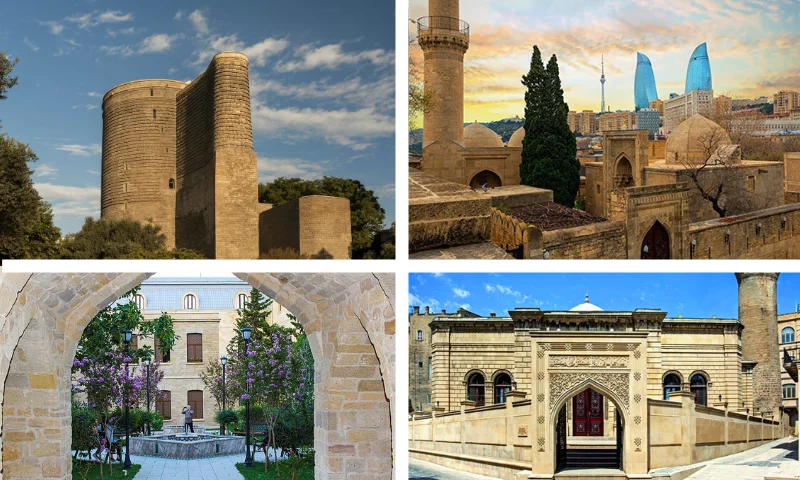
The final part of the route takes guests to Icherisheher — the historical heart of Baku and a UNESCO World Heritage Site surrounded by ancient fortress walls. Narrow stone streets, hidden courtyards, and centuries-old architecture create the atmosphere of a living open-air museum where history can be felt in every detail. During the walk, visitors discover the Maiden Tower, the Palace of the Shirvanshahs, ancient caravanserais, and traditional architectural landmarks preserved from different historical periods.
For centuries, Icherisheher stood at the crossroads of major trade routes connecting Europe and Asia, shaping a unique blend of cultures, architecture, and civilizations inside the Old City walls. Many historians consider this district one of the most important preserved medieval urban areas in the Caucasus, where traces of Persian, Ottoman, Shirvanshah, and Russian influence can still be seen throughout the ancient streets. Today, the Old City tour remains one of the most memorable cultural experiences in the capital, where history, panoramic scenery, and contemporary architecture come together in a refined Baku sightseeing tour. For many international visitors, this experience becomes the ideal azerbaijan tour for discovering the spirit of Baku in a single day.
The Gobustan tour begins with a historic highlight — the first mechanically drilled oil well in the world, located in the Bibi-Heybat area of Baku. Completed in 1846 under the guidance of engineer Vasily Semyonov, this well marked the start of modern oil industry. At a depth of 21 meters, it preceded the famous Drake well in Pennsylvania by more than a decade. The site symbolizes industrial progress and the region’s economic power, attracting magnates such as Nobel and Rothschild. As part of our azerbaijan tours, visitors can see the restored well and learn about the pioneering stages of oil exploration and its impact on global history. bal history.
The next stop is the tours to Mud Volcanoes, one of Azerbaijan’s unique natural wonders. Visitors will see active craters where the earth seems to breathe with magical energy. Local legends tell of jinns and mystical events occurring in these lands. Walking along the paths, you can feel the atmosphere of ancient beliefs and admire the lunar-like landscapes. Mud volcanoes amaze not only with their natural beauty but also demonstrate the geological diversity of the region. This part of the tour combines nature exploration with a touch of mystery, making the experience particularly memorable and engaging.
Next, we head to the heart of tours azerbaijan — the Gobustan National Reserve. Here, you will encounter a unique prehistoric settlement preserved for thousands of years. Visitors can explore Paleolithic dwellings, study ancient tools, and learn about the art and customs of early civilizations. The museum and the reserve provide a deep dive into the past, showcasing the evolution of Homo sapiens. Expert guides explain the significance of archaeological findings and how this land shaped Azerbaijani culture. This part of the tour blends education and entertainment, making the Gobustan experience unforgettable.
The museum doesn't start with information boards — it starts with silence. The soft light makes you stop and look closely before you read a single word. On the walls, you see exact copies of the rock carvings you will find outside, just a few minutes later. Next to them are real stone tools and the bones of animals that died out long before the first humans came here.
Touch screens let you zoom in on every mark on the stone. Short videos bring old hunting scenes and ritual dances to life, and for a moment, the line between the display and real life feels thin. One room is about the mud volcanoes — the slow, quiet breath of the earth that has continued here for millions of years. After these rooms, the rock carvings outside feel different. They no longer feel like the start of the story — they feel like its continuation.
During the visit, you will see the famous Gobustan petroglyphs, left by our ancestors. The carvings depict hunting scenes, daily life, and spiritual practices of ancient humans. Guides explain the evolution of society, survival skills, and social structures of prehistoric communities. Observing these rock drawings, you feel how the past connects with the present, making the distance between us and ancient civilizations seem smaller. This experience allows guests to understand the culture and lifestyle of early humans and highlights the importance of preserving historical heritage.
The tour continues with the Absheron tours, including a visit to the ancient Ateshgah Fire Temple. This sacred structure, built by Hindu Brahmins and Zoroastrians, symbolizes worship of the eternal flame. Located on the Absheron Peninsula, where natural gas sources produce a continuous fire, the temple reveals the region’s rituals, culture, and religious traditions. Visitors can admire the impressive architecture and feel the harmony between nature and spirituality, understanding Absheron’s historical and religious significance.
The final highlight of the tour is the legendary Yanardag, known as the Burning Mountain. Flames emerge directly from the ground, creating a unique natural phenomenon that attracts visitors from all over the world. From the viewing platform, you can see a third of the Absheron Peninsula, while the eternal fire creates an unforgettable atmosphere. This site is a symbol of the region’s geological richness and natural uniqueness. Completing the tour, guests participating in our azerbaijan tours gain a full understanding of the culture, history, and nature of Absheron and Gobustan. This day leaves lasting impressions and a desire to return.
Shamakhi is a city with deep historical roots and the former capital of the Shirvanshah state. Poets, philosophers and scientists were born here, and their works became part of world culture. The main stop is the Juma Mosque, built in 743. It is one of the oldest mosques in the Caucasus, and you can see why: strict lines, a balanced shape, an age that you can feel. During the stop you can look at the details of the building and learn about the role of the mosque in the history of the region. This is how tours around the regions of Azerbaijan begin, where in a few hours of driving both the landscape and the era change.
After the mosque, the road goes through the thick forests of the Ismayilli district. Oaks, maples and rare plants grow here. It is quiet, and nature seems to be in no hurry. These forests are the green heart of the country.
Next, the road comes to a suspension bridge over a fast mountain river. A walk on the bridge gives a feeling of adventure, and around you there are views of the Caucasus mountains with forested slopes. There is time for photos and a short break, and the place shows well the character of northern Azerbaijan. Tours in Azerbaijan are not always only sightseeing: at this stop you walk across the bridge yourself, and you do not just look at it from a window.
Gabala is an ancient city and was once the capital of Caucasian Albania. The main part of the tour in Gabala starts at the restaurant, where the group stops for lunch. The restaurant stands on a hill, and from its windows you see a wide view of the valley and the mountains. Here you can try traditional Azerbaijani dishes: they tell you more about the tastes of the region than any story. You can also order classic European dishes. During lunch you can rest calmly before the next part of the road. Azerbaijan tours are remembered not only for the views: the taste of local food stays in your memory just as long.
It is about 15 minutes from the restaurant to the waterfall, and the road itself is worth your attention: outside the window there are mountain slopes and forest views. "Seven Beauties" is one of the most beautiful places in Gabala. The water falls over several impressive steps in the thick forest, and it is noticeably cooler near it. The name is connected with a local legend, and this makes the place more mysterious. At the waterfall you can breathe mountain air and take photos.
After the waterfall, the route goes up to the Tufandag ski resort, one of the biggest in Azerbaijan. In winter people ski here, and in other months they come for walks around the area and views from the cable car. From the highest point of the resort you can see the Sleeping Beauty peak (Yatmysh Gezel), which rises about two thousand meters above sea level, and Mount Tufandag, one of the highest mountains in Azerbaijan.
When the last walk at Tufandag ends, the evening part of the route begins. We go from Gabala to Sheki, an old city where you will spend the night. We usually arrive there at about 18:00. You do not need to return to Baku: we take you to your hotel in the center of Sheki, and the tour ends there. The next day you can start with walks, not with a drive.
The route starts with the main sight of Sheki. The palace was built in 1762 for the rulers of the Sheki Khanate, and it is often part of tours around the regions of Azerbaijan. Look at the windows: the patterned frames of wood and colored glass are put together without nails or glue, and the light falls on the walls in many colors. Inside, you can still see wall paintings. The guide will tell you how the khans lived and why people see this palace as a symbol of the city.
From the palace, you walk to the old part of the city, to the caravanserai. Merchants who traveled along the Silk Road once stayed here. Today, shops with local crafts are open under the arches. You can walk along the rows, look at the work of the craftsmen and choose a souvenir. Places like this make tours in Azerbaijan interesting: people still trade inside these old walls.
Next, the road goes up to the panoramic park. From here you can see the whole city: red tile roofs, green slopes and mountains on the horizon. You can take photos here and rest for a little while.
The next stop is the village of Kish, a few kilometers from Sheki. It is calmer here than in the city, and at the table you can try local food. This stop gives Azerbaijan tours something that museums do not have: the taste of the region and a calm day in the village.
After lunch, you walk to the temple of Caucasian Albania. According to tradition, it is one of the oldest Christian temples in the region. The ancient walls and the silence around them create a special mood. The guide will tell you about Albanian culture and how the temple is connected with the history of Azerbaijan.
Next, the road leads to Gabala, one of the ancient cities of Azerbaijan. Here you have a break for tea in Gabala: you can get some fresh air and rest a little before the road to Baku.
The transfer from Sheki to Baku is included in the tour, so after sightseeing you do not need to look for a taxi or a minibus. You travel without changes, and the mountains slowly give way to the plain.
Our journey begins early in the morning in the capital of Azerbaijan — Baku. Leaving the city behind, the group travels toward the first natural attraction of the route — the famous Masazir Pink Lake.
This is one of the most unusual lakes in the country, well known for its rare natural color. Only a few lakes like this exist in the world, and Masazir Lake holds a special place among them because of its rich palette of pink shades.
The unusual color of the water appears thanks to halophilic algae that live in salty water and produce a natural pigment called carotenoid. Depending on the level of salt and the amount of sunlight, the surface of the lake can change its shades from soft pastel pink to bright and intense colors. Because of this unique phenomenon, many travelers join a Pink Lake tour to see this natural wonder with their own eyes.
Besides its unusual beauty, the Pink Lake has historically been an important place for salt production. Local people collected salt here for generations using traditional methods, and today this area still keeps traces of centuries-old salt harvesting traditions.
The lake is not visited from August 1 to May 10 because during this period the water usually loses its pink shade.
The next stop on the way to the highland village leads travelers to the Khizi region. Here guests make a stop at the foothills of the Greater Caucasus Mountains, which gradually transform into an unusual natural phenomenon — the colorful hills of Khizi.
Historically this region has been home to the Daglis, a sub-ethnic group of Iranian origin connected to Azerbaijani Persians and considered one of the few European Persian communities.
Khizi is famous for its extraordinary landscapes. The local mountains are often called Agate Mountains, Rainbow Mountains, or Candy Cane Mountains because of their bright striped slopes. Red, orange, purple, and pink layers resemble colorful minerals and create a stunning natural pattern across the hills.
The winding road passes through these amazing landscapes and opens panoramic views that impress even experienced travelers. Many visitors specifically choose a tour to Candy Cane mountains in order to witness one of the most unusual natural formations in the country and better understand how diverse tours in Azerbaijan can be.
About one hundred kilometers from Baku, the famous Mount Beshbarmag appears on the horizon. Its name translates as “Five Fingers,” and for centuries this peak has been considered a sacred place with an important role in local traditions.
For a long time this territory was inhabited by Azerbaijani Daglis who belong to ancient Iranian tribes of the region. Many legends are connected with this mountain. One of the most famous stories speaks about the Quranic figure Khidr, who in local traditions is believed to be the protector of travelers.
Guests traveling along this route usually make a stop here to rest. Visitors can enjoy beautiful views of the Caucasus Mountains, listen to stories from the guide, and relax after the road.
The bus stops at a public parking area that offers an impressive panoramic view of the Greater Caucasus range. In this place visitors can see old caravan stops, a mosque, small shops, and local cafes. Since ancient times Beshbarmag has been a place of pilgrimage, and many people still believe that this place has special energy and can help wishes come true.
The next part of the route passes through one of the most picturesque forest areas of northern Azerbaijan — the Gechresh Forest. This dense and green forest leaves a strong impression on travelers thanks to its natural beauty.
The road goes between tall trees whose thick branches form a natural green tunnel. In summer the leaves almost completely cover the sky, creating a cool and peaceful atmosphere.
The scenery here looks like something from a fairy tale: a winding road stretches through the forest while a mountain river flows nearby. With every kilometer travelers get closer to the high mountain areas of the Caucasus.
In this beautiful forest guests will stop for lunch. Visitors can try traditional Azerbaijani dishes prepared according to local recipes while enjoying fresh mountain air and the calm atmosphere of nature. Local restaurants offer a variety of meals, and prices remain quite affordable for travelers.
One of the most impressive natural places along the route is the Gudialchay River Gorge. From a geological point of view, this territory is considered one of the oldest natural zones in the region.
The road runs between high cliffs while a powerful mountain river flows nearby. About thirty minutes of travel through this area allows visitors to fully experience the atmosphere of wild nature and feel the strength of the mountain landscape.
Places like this make tours around the regions of Azerbaijan truly unforgettable. The contrast between cliffs, river water, and fresh mountain air creates a feeling of complete connection with nature and allows travelers to forget about the noise of the city
The main destination of the journey is the ancient highland village of Khinaliq. The road to the village passes through the majestic peaks of the Greater Caucasus and rises to an altitude of about 2500 meters above sea level.
Khinaliq is considered one of the highest and oldest settlements in the Caucasus. Local residents speak a unique language that has no close equivalent among other languages in the region.
Narrow streets, stone houses, and ancient architecture create the impression of a living open-air museum. Many historians believe that the settlement may be around four thousand years old.
According to local legends, the village was founded by ancient tribes who found shelter among the mountain peaks. During the walk through the village guests learn fascinating facts about the history and culture of Khinaliq, discover the traditions of its residents, and see the unique lifestyle of a mountain community.
After exploring this ancient village, travelers return to Baku. The road passes through the same mountain landscapes, which now appear from a new perspective. This route remains one of the most impressive tours in Azerbaijan, allowing visitors to experience the rich nature, history, and culture of the northern regions of the country. Many travelers who join the Tour to Khinaliq say that it becomes one of the most memorable experiences among all azerbaijan tours
Check-out and transfer from your hotel to the airport.
Tour Category:
Multi-day Tours
Group Size:
1-17 people
Duration:
What's Included
- test 1
What's Not Included
- test 2
- Accommodation
- Arrival transfer
- Departure transfer
Note
test 3
Customer Reviews (0)
Leave a Review