In 1968, director Leonid Gaidai made a bold decision. He needed to show Soviet audiences an exotic foreign land—Istanbul, a Turkish city with an Eastern atmosphere, where the heroes of his new comedy would travel. But how could he show a foreign country when the Cold War was at its height, the Iron Curtain separated nations, and recognizing a foreign state as "abroad" in the USSR was nearly an act of treason? Gaidai found a solution. He went to Baku.
In September 1968, the film crew of "Diamond Arm" flew to Azerbaijan. Here, in the historic center of Baku, in the ancient quarters of the Old City, among mighty fortress walls and narrow stone streets, they filmed what viewers were meant to accept as a Turkish city. The idea was brilliant in its simplicity: Baku's medieval architecture, its Eastern atmosphere, narrow streets, and history-laden neighborhoods easily passed for a foreign city. All that was needed were a few props, and Soviet censors would turn a blind eye.
Above building facades appeared signs in unfamiliar languages—"Lampade-Radio," "Cafe's Scifo," "Philips." Even the Maiden Tower, one of Baku's principal symbols, received mysterious English letters "NIP INDIA." No censor bothered with details. What mattered was that the Soviet tourist on screen saw something exotic, something that didn't exist in the USSR. And Soviet viewers believed it. They believed they were watching Istanbul. No one even thought it might be Baku.
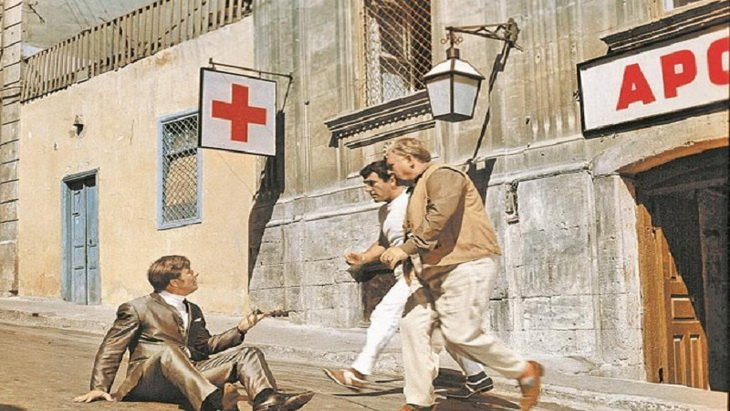
The most famous scene of the film—the one that became a meme long before internet memes existed—the scene of Kozodoyev's fall with the cry "Damn it!"—was filmed on Kichik Gala Street in the very heart of the Old City. If you go to this place today, you'll find an ordinary narrow Baku street with brick walls, ancient houses, and modern traffic. There's no memorial there. But tourists come here, stand on the exact spot where Yuri Nikitin's character fell, and take photographs. Some even try to fall the same way as in the film, but cars pass frequently, so it's not always safe.
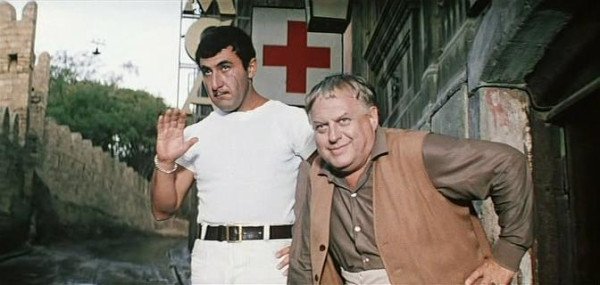
On the same street was the "pharmacy" where Gorbunkov was supposed to break his arm and the plaster with "diamonds" was applied. On the neighboring Sabir Street, near the "Hurma" café, by the Twin Gates of the Old City, other famous scenes were filmed—the meeting of Soviet tourists with a woman of loose morals, who sang her melancholy serenade: "Tsigel-tsigel, ay-lyu-lyu."
Other symbols of Baku appeared in the frame. The Maiden Tower, the most mysterious structure in the city, stood as a silent witness to events unfolding. The Shirvanshahs Palace, a magnificent medieval building, was introduced through the tour guide's story—a character played by Yuri Nikitin's wife. She called it the palace of an invented sultan, and this became part of the picture of an exotic foreign city.
The Juma Mosque, one of Baku's oldest mosques, also appeared in the film. There was even a scene where Semyon Semyonovich Gorbunkov (played by Oleg Efremov) tried to photograph camels at the mosque with his camera lens closed—such was Soviet concern for observing propriety in holy places.
Director Gaidai worked like an illusionist. He employed tricks to circumvent Soviet censorship's objections, to show something that formally could not be shown. Baku became his accomplice in this game. The ancient Azerbaijani city, with its powerful architecture, Eastern atmosphere, and unique character, allowed the Soviet director to create the illusion of a foreign country without leaving the Soviet Union.
The film was released in 1969 and became a legend of Soviet cinema. It was one of the funniest comedies of the Soviet era, and it swept through Soviet cinemas like a hurricane. People laughed at Kozodoyev's incompetence, at his attempts to return the diamond arm to smugglers, at the chaos that accompanied his adventures in the "Turkish" city.
But few knew that this "foreign city" was on Soviet soil, in the capital of one of the Soviet republics. Even today, decades later, people come to Baku not for the ancient architecture, not for oil, not for the Caspian Sea, but to see the place where Nikitin's character fell on the cobblestones of an old street with a cry of "Damn it!"
It was Gaidai's brilliant idea—to use reality instead of sets, to use a real Azerbaijani city instead of a theatrical mock-up, to use history instead of studio imitation of history. And the city played its role so well that millions of Soviet people believed they had seen Istanbul when in reality they were watching Baku.
Today, tourists walk through Baku's Old City searching for filming locations from "Diamond Arm." They look for Kichik Gala Street, stand at the spot where Kozodoyev fell, photograph themselves against the backdrop of the Maiden Tower. It's a strange form of pilgrimage—people come not to pray but to remember a cult film of their youth. But it shows how art, history, and reality intertwine, how one film can unite viewers across centuries and borders, and how a small Azerbaijani city once played the role of a protagonist in the history of Soviet cinema.
If you want to fully immerse yourself in the history of Baku's Old City and visit all the filming locations of "Diamond Arm," it is recommended to book a walking tour of the Old City. Experienced guides will show you Kichik Gala Street, where Kozodoyev utters his famous phrase, guide you along the route of the film's heroes, and share stories about how the legendary comedy was shot among these ancient walls. This will allow you not only to see the filming locations but also to feel the atmosphere that inspired director Gaidai to create one of the most famous films of Soviet cinema.
Comments (0)
Leave a Comment