On the very summit of Mount Kyzylkaya, in a place where clouds hover at eye level, at a height of 2,100–2,200 meters above sea level, hides one of the world's most ancient settlements. This is the village of Khinalig—a place where, it seems, time forgot to count seconds and centuries. Here live people who have preserved their culture and language exactly as they were five thousand years ago, when humanity was still writing its history in sand and blood.
Khinalig has existed for more than five millennia. This is not just a number—it is an entire epoch, longer than the history of ancient Rome, longer than the history of modern states. When the pyramids of Egypt were being built, when civilization was emerging on the banks of the Tigris and Euphrates, when Sumerians were writing the first laws on clay tablets, people were already living in Khinalig, in the mountains of the Caucasus, in a place so difficult to reach that the entire world forgot of its existence.
The Roman historian Pliny mentions the Kiety—as the inhabitants of Khinalig call themselves—in his works from the first century AD. Strabo in his famous "Geography" also left notes about this mysterious people. The Khinalig people themselves consider themselves direct descendants of the biblical Noah, and this belief, passed down from generation to generation, reflects the depth of their connection to their land and history. They are not conquerors or wanderers who came from afar. They are mountain people, people who have grown together with every stone, every cliff, every breath of wind for thousands of years.
Eight ancient cemeteries, scattered around the village, occupy an area far exceeding the territory of Khinalig itself. These are not cemeteries of one generation or one century—they are cemeteries of entire epochs. Here lie burials in three, sometimes even four layers, testifying to the continuous habitation of this place, to the birth, life, and death of people on the same earth, in the same place. Stone gravestones bear inscriptions in different alphabets—evidence of contact with different cultures, different ages, but never interrupted connections with one's roots.
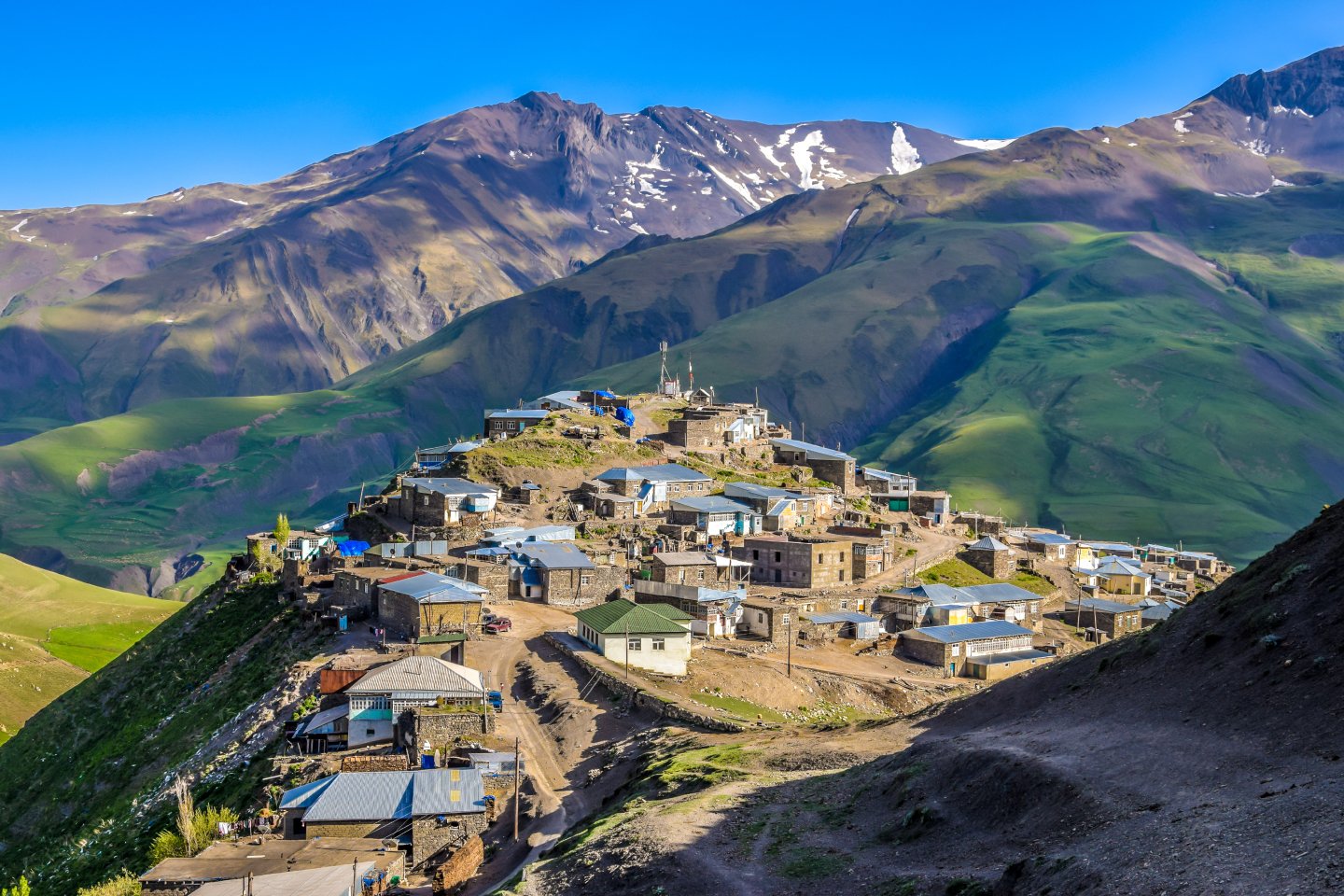
The architecture of Khinalig is unique and practically unknown anywhere else in the world. Houses here are not arranged in ordinary fashion—they terrace the mountainside like a vineyard, where each level depends on the level below it. The roof of one house serves as a courtyard for another house located higher. This is not a whim or oddity—it is the result of centuries of adaptation to life on a vertical cliff, where there is no flat ground, where one must ask every centimeter of space from the mountain itself. Many of these houses are over two hundred years old. They stand on the mountain as living witnesses to time, their walls remembering events that humanity has forgotten.
But the most remarkable thing about Khinalig is its language. The Khinalig language is a linguistic miracle, a linguist's dream and a nightmare for those trying to learn it. It belongs to no known language group and resembles no other language on Earth. It has 77 letters—59 consonants and 18 vowels—and a full 19 cases! By comparison, Russian has 33 letters and 6 cases, English has 26 letters and no cases at all. The Khinalig language is evidence of isolation, proof that people developed in the absence of contact with the outside world, creating their own unique way of expressing thought.
The inhabitants of Khinalig are divided into four main clans. Each clan has its own cemetery, its own patterns for carpets and clothing traditions. They have known each other by name for centuries, know the history of every family, every branch on the genealogical tree. Despite their hospitality to travelers and tourists, Khinalig people are strict about admitting new members to their community. Outsiders are not permitted to settle here—this is a clear, unwritten rule. Moreover, they traditionally oppose marriages between members of different clans and, especially, between Khinalig residents and people from other villages. This is not hatred or contempt for other people. It is a desire to preserve, protect, safeguard their uniqueness in a world that seeks to standardize everything, to make everything the same.
Khinalig's history is so ancient that its people even requested autonomy from Azerbaijan's authorities—a desire to be independent in their mountain enclave. This was not an aggressive demand. It was a quiet, but firm expression of the desire to remain themselves, to preserve their way of life, their customs, their language, their identity.
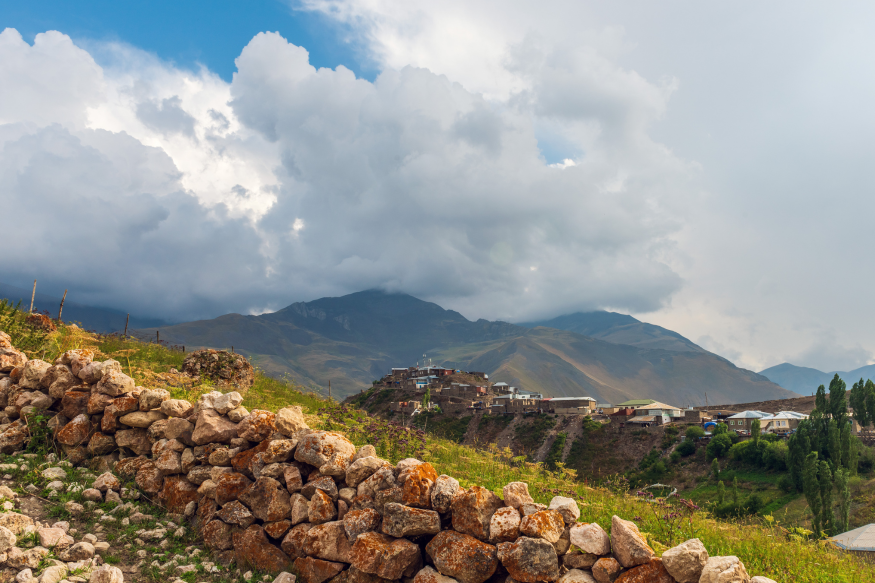
On the territory of the village stands a temple of Zoroastrians—adherents of the ancient religion of Fire. This temple emerged on the site of a natural gas vent creating an eternal, inextinguishable flame, in the ninth century AD. The fire has burned here for over a thousand years, symbolizing the connection between earth, sky, the divine, and the human.
In 2019, the Museum of Unique Heritage opened in Khinalig, where carpets, manuscripts, jewelry, ancient coins, and even Roman phalerae—metal discs that served as insignia in Rome—are collected. The museum's exhibits tell the story of contact, the story of trade, the story of how this small people, lost in the mountains, nevertheless remained part of the larger world, trading, communicating, exchanging culture.
In 2023, Azerbaijan created the "Khinalig and Köç Yolu" Reserve, which included a 200-kilometer transhumance route from Khinalig to Pirsagat Reservoir—an ancient path traveled by herders, used to transport goods, connecting mountain regions with plains. This reserve was recognized by UNESCO as a World Heritage site—the cultural landscape of the Khinalig people.
Visiting Khinalig has become an increasingly popular destination for tourists interested in history and culture. Tours in Azerbaijan today often include this unique village in their itineraries, allowing travelers from around the world to become acquainted with this ancient world. Climbing mountains, visiting museums, meeting local residents—all of this becomes part of an unforgettable experience.
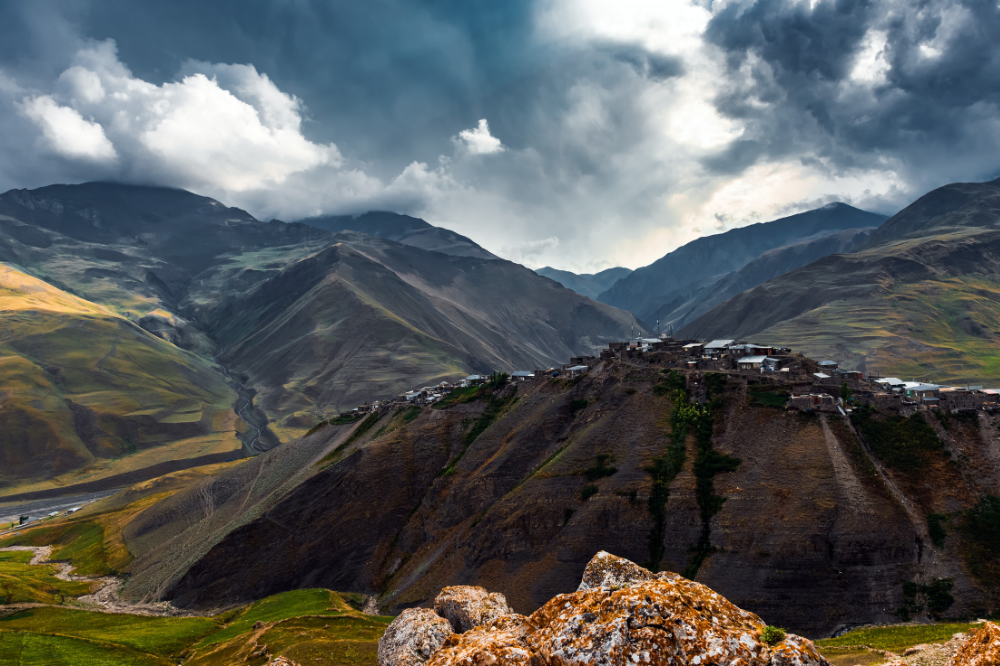
A trip to Khinalig is not simply a tourist excursion. It is a journey into the past, to a place where the past is still alive and breathing. When you climb narrow trails between terraced houses, past residents who gaze upon you with curiosity and kindness, you feel the weight of history, the weight of millennia. You see houses in which people live the same way their ancestors lived two hundred years ago. You hear a language spoken by people before writing was invented among neighboring peoples. You stand at the edge of an abyss, surrounded by clouds, and understand why people chose this place five thousand years ago and why they cling to it so stubbornly today.
Tours in regional Azerbaijan, including routes through mountain areas, offer travelers an entirely new understanding of the country. Khinalig is not merely one of many attractions; it is a symbol of how human culture can survive millennia while remaining true to itself. The proximity to other mountainous regions of Azerbaijan, such as river valleys, nature reserves, and high-altitude plateaus, makes visiting Khinalig part of a broader journey through Caucasian treasures.
Khinalig is a reminder that humanity is diverse, that culture and tradition can be preserved for centuries, that language and identity are not merely words but a living fabric that connects us to our past. It is a place where the flow of time forgot to run, where people live in harmony with their history, and where every stone, every house, every word is a correspondence between past and present.
If you wish to experience this unique atmosphere and meet a culture that exists outside of time, it is recommended to book an excursion to Khinalig through authorized travel agencies. Professional guides will help you safely climb into the mountains, explain the history of each location, introduce you to local residents, and help you understand the depth and beauty of this ancient village. Tours are organized year-round, but the best time to visit is spring (April-May) and fall (September-October), when the weather is stable and nature is particularly beautiful.
Comments (0)
Leave a Comment